
Home › Guide
Guide
Geyser not heating or tripping the electricity: what to check
When a geyser stops heating, it has almost always failed at one of three points: the element, the thermostat or the power supply. Check the distribution board first. If the geyser breaker or the earth leakage has tripped, and trips again when you reset it, leave it off and call a plumber: the element has probably failed, and the geyser is not safe to use.
- Since 2013
- PIRB registered · COCs issued
- 5.0 from 21 Google reviews
- 24-hour emergency call-outs
- Free written estimates
Check these first
You can check these yourself without opening the geyser:
- The distribution board: is the geyser breaker, the isolator or the earth leakage switch off? Reset it once.
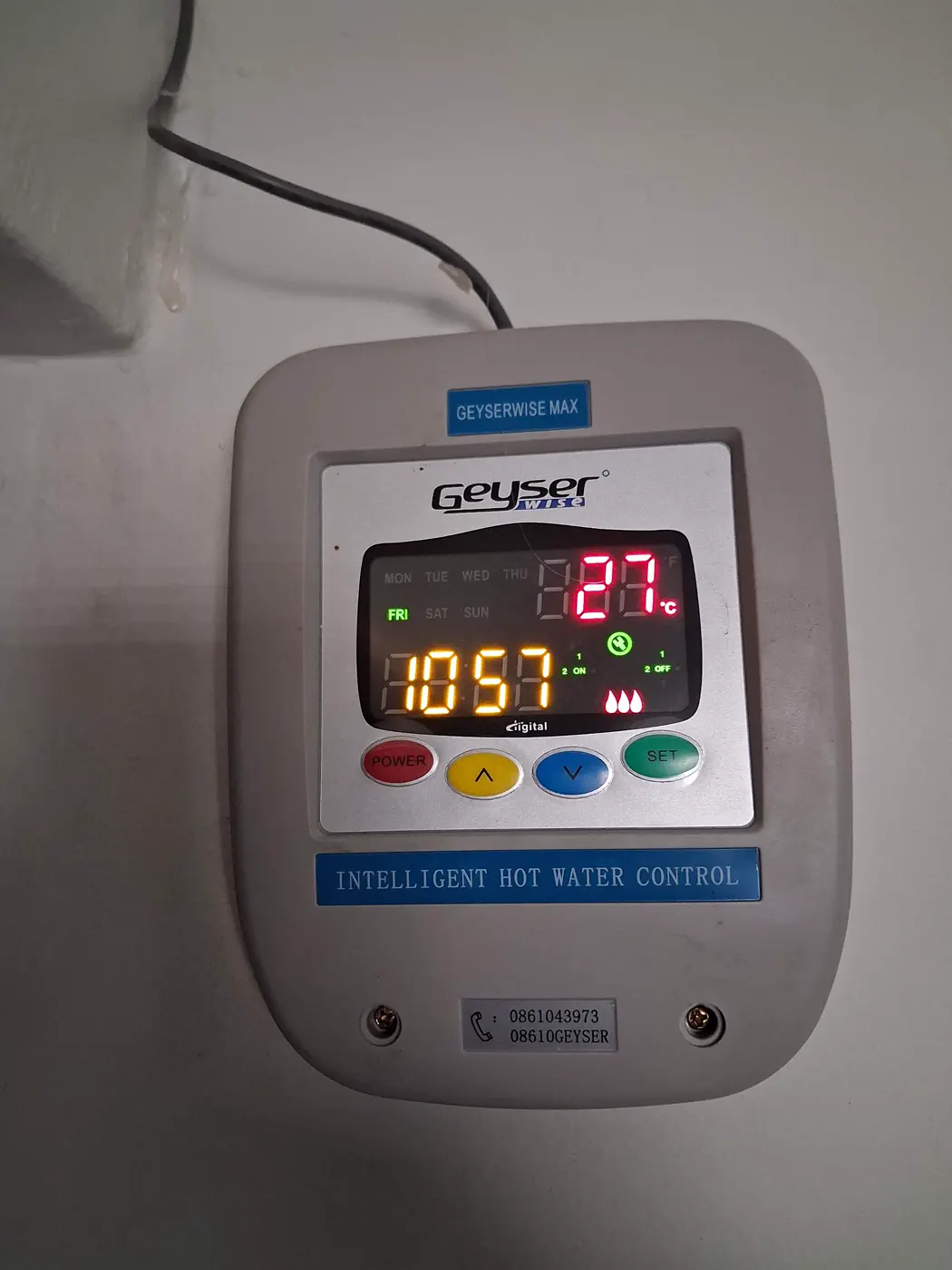
- The timer or controller: if the geyser runs on a timer or a GeyserWise controller, check the clock, the schedule, the set temperature and whether it shows an error code.
- After a power cut, whether the timer or controller came back on at all.
- The overflow pipe outside: water running from it all the time is a different fault, which our overflow guide covers.
Anything inside the geyser’s cover, the element, the thermostat and the wiring, is work for a plumber or an electrician. Kwikot says testing them needs the supply isolated and a multimeter.
If it trips the earth leakage
A tripped earth leakage or geyser breaker usually means the element has failed and gone to earth: a crack in its sheath lets current reach the water. Kwikot’s advice is to stop using the geyser and call a plumber. Resetting the switch again and again does not fix it.
If a GeyserWise controller shows E1, the earth leakage code, GeyserWise recommends calling an electrician or one of its technicians.
If the water is lukewarm but never hot
Kwikot puts this down to a thermostat set too low, a failed upper element in a geyser with two elements, or heavy scale on the element.
A thermostat can fail the other way too. One that sticks closed leaves the element running non-stop, which wastes electricity and overheats the water. Because the element and thermostat so often fail together, Kwikot advises replacing them as a pair.
What temperature should a geyser be set to?
Set it to 60°C. Eskom recommends 60°C to save electricity, and Kwikot says a minimum of 60°C all year round. The World Health Organization explains why not lower: Legionella bacteria grow between 20°C and 50°C, and keeping hot water above 50°C needs the water leaving the heater at 60°C or more.
Eskom estimates a saving of 3 to 5% on water heating for every 10°C you turn it down, so a geyser set above 60°C costs money for no benefit. If the geyser has been off for days, Kwikot advises running a full 60°C cycle before heavy use.
Element, thermostat or a new geyser?
Kwikot recommends replacing the element every five to seven years as part of normal servicing, and puts the life of the tank at eight to twelve years with a service every three to four years. An element or a thermostat is a part, so replacing it is a repair. A tank that leaks cannot be repaired, and that is when it is time for a new geyser, or for solar or a heat pump.
When to call ProSol
Call 081 559 2180 at any hour if the geyser trips the power and will not stay on, or if water is coming through the ceiling. For a geyser that is simply not heating, send a photo of the distribution board and the geyser on WhatsApp, and Malan will tell you what it needs. Planned work, like a new geyser or a move to solar, gets a free written estimate before we start.
Questions people ask
Why is my geyser not heating?
Almost always a failed element, a failed thermostat, or no power reaching the geyser. Check the geyser breaker and the earth leakage at the distribution board, and the timer or controller if you have one. If those are fine and the water stays cold, the element or thermostat needs replacing.
Why does my geyser keep tripping the electricity?
Usually because the element has cracked and gone to earth, so current leaks into the water and the earth leakage trips. Stop using the geyser and call a plumber; resetting it again and again does not fix it.
What temperature should I set my geyser to?
60°C. Eskom and Kwikot both recommend it, and the World Health Organization says hot water should leave the heater at 60°C or more to keep Legionella bacteria from growing.
How many years should a geyser last?
Kwikot puts the life of a geyser tank at eight to twelve years with a service every three to four years, and recommends replacing the element every five to seven years.
Can I replace a geyser element myself?
No. Kwikot says an element must be replaced by a plumber or an electrician, with the geyser switched off at the distribution board, not just at the isolator.
Related
- Geyser repair and replacementBurst or failing geyser in Stellenbosch, Somerset West or Paarl? ProSol repairs and replaces geysers to SANS 10254, with the certificate your insurer asks for.
- Geyser overflow pipe drippingA few drips while the geyser heats are normal; a constant trickle is not. Which pipe is which, what each leak means, and why you must never block it.
- Emergency plumbingBurst pipe, burst geyser or a leak you cannot stop in Stellenbosch, Somerset West or Paarl? ProSol takes emergency call-outs 24/7. Call 081 559 2180.
- Solar geyser repairs and servicingSolar geyser not heating, leaking or showing an error code? ProSol repairs and services Kwiksol, ITS Solar and other makes in Stellenbosch and the Winelands.
Areas we serve
What customers say
“During the huge April 2024 storm in Stellenbosch, I phoned Malan at Prosol on Sunday morning. I had thought with so many houses damaged here, it would be nearly impossible to get help at short notice. By 10 am his two men were here.”
“Prosol plumbing is very proffesional, efficient and cares about their ckients. They are very reliable and the staff is very patient and pay attention to detail.”
“Malan & his Prosol team were commented as being very professional and efficient with the geyser install at Consol Shop Stellenbosch.”
Tell us what’s wrong. We’ll tell you what it takes.
Phone for anything urgent, at any hour. Otherwise send a photo and a few words on WhatsApp, and Malan comes back to you with what it needs. Planned work gets a free written estimate before we start.